Join our mobile Rapid Response Network!
You can be the first to hear about how we’re going to hold this administration accountable and how you can fight back for wildlife!
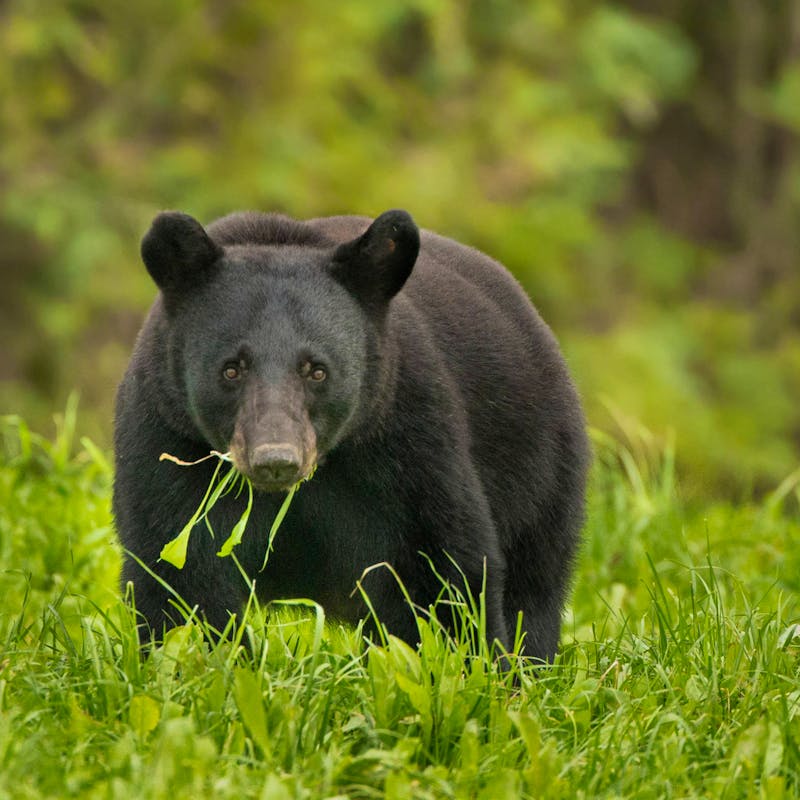
American black bears are only found in North America and are the most widespread of the three bears species found on the continent.
They have short, non-retractable claws, making them excellent tree-climbers.
Despite their name, black bears can exhibit a variety of coat colors. The classic fur is considered uniform black with a brown muzzle and the occasional white chest marking. In certain regions, such as the western United States, they commonly also display brown, cinnamon and blond colorations. The bluish-gray coloration in Southeastern Alaska, known as glacier bears, and white fur in coastal British Columbia, known as the kermode or spirit bear, are only found in these areas. The variety of coat colors is thought to allow these bears to adapt to diverse environments.
Are black bears endangered?
Although black bears are not currently state or federally listed in the U.S., they experienced large reductions in numbers and contractions in range prior to the development of better wildlife management practices.
They are considered a recovery success story, as they have rebounded in areas they were previously extirpated, thanks to conservation and restoration efforts. For example, the Louisiana subspecies (Ursus americanus luteolus) was listed as threatened under the Endangered Species Act in 1992 due to overhunting and habitat loss, but was determined recovered and delisted in 2016. The Florida subspecies (Ursus americanus floridanus) was listed as state-threatened in 1974. With associated protection and dedicated conservation efforts, the population rebounded in several areas. Florida black bears were delisted in 2012, although some subpopulations remain isolated.
The greatest threats to black bears across their range include habitat loss and fragmentation, Natural food failures and disease. These bears also have to navigate increasingly urban environments, which can lead to human-bear conflicts and vehicle collisions.

Defenders' Impact
Defenders of Wildlife was instrumental in black bear recovery efforts. Today, we continue to advocate for coexistence. We work with several state wildlife agencies to develop long-term management plans.
For example, we work with the Florida Fish and Wildlife Conservation Commission on developing long-term plans for managing and connecting bear habitat throughout the state. Defenders also collaborates with transportation agencies in the Southeast to reduce bear mortality on roads. We have provided a variety of coexistence programs and resources, such as community outreach and bear-resistant dumpsters, to help prevent human-bear conflicts. The Conserve Wildlife license plate spearheaded by Defenders has raised over $9.5M for Florida wildlife, with 25% of that benefiting Florida black bears and their habitat.
What You Can Do
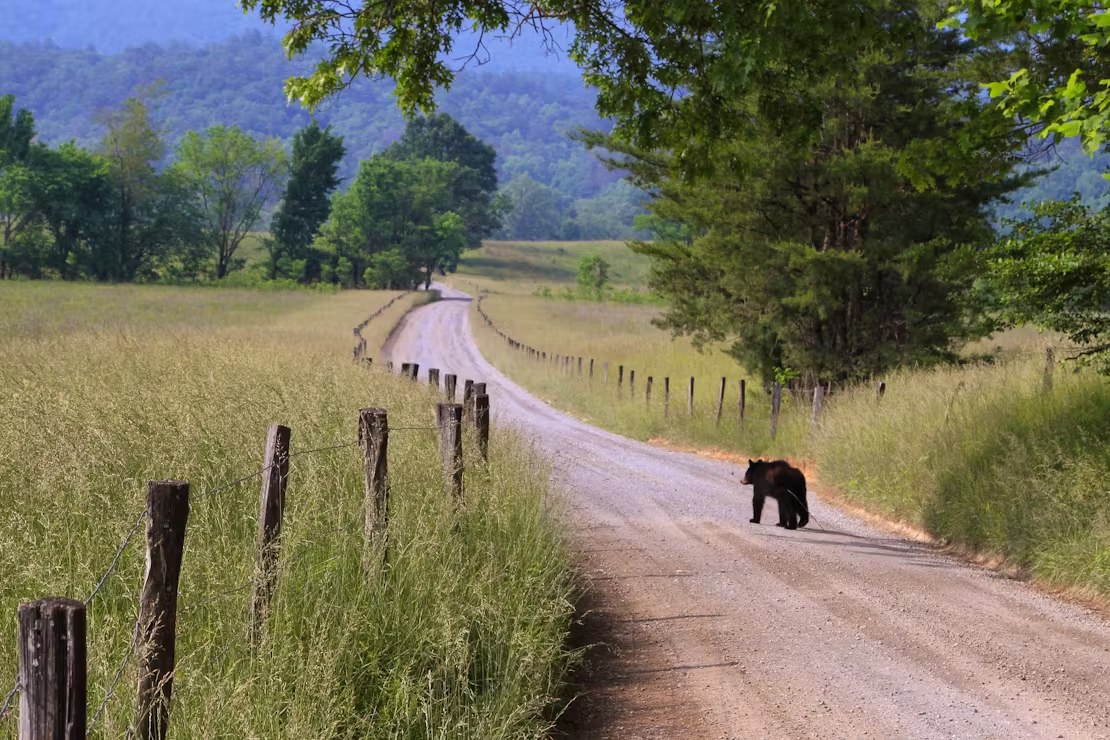
If you live in, or are visiting, black bear country, avoid attracting bears into neighborhoods, campgrounds or near roads with food items. If you are lucky enough to see a bear in the wild, please respect its space and keep your distance. Also, be sure to drive slowly and watch out for bears and other wildlife.
Everyone can advocate for the protection of private, state and federal land that is habitat for bears.
About
The American black bear is the most widely distributed of the three bear species in North America, found from Canada to Mexico and in at least 40 states in the U.S. They are extremely adaptable and capable of surviving in a variety of habitats from desert scrubland to dense temperate forests. They generally prefer areas with vegetative cover compared to their cousin, the grizzly bear, that prefers open areas.
There are at least 850,000 to 950,000 black bears estimated in North America. In the contiguous U.S., there are estimated to be over 300,000 individuals. However, the Louisiana black bear (Ursus americanus luteolu) and Florida black bear (Ursus americanus floridanus) are unique subspecies with small populations. More than 4,000 Florida black bears and an estimated 750 to 1,000 Louisiana black bears, the state’s mammal.
Black bears tend to be solitary animals, with the exception of mothers and cubs. The bears usually forage alone but will tolerate each other and forage in groups if there is an abundance of food.
Most black bears undergo torpor during the winter months. During torpor bears enter a den, limit their activity and may completely halt their digestion – meaning they do not eat, urinate or defecate – sometimes for up to 7 months! This behavior is driven by low food availability and is dependent on latitude; bears in southern climates – such as Florida – enter torpor for shorter periods, whereas bears in northern climates – such as Minnesota – are in torpor for longer periods. They will den under heavy brush, in hollow areas under rocks or logs and in hollow trees.
Black bears are slow reproducers. They typically do not have cubs until age 3 to 5 years and litter sizes are small, at around two cubs on average. Cubs remain with their mother for a year and a half or more, even though they are weaned at 6 to 8 months old. Females only reproduce every second year or less frequently, unless her young die for some reason, then she may reproduce again after only one year.
Mating Season: Summer
Gestation: 7 to 8 months with most development in the final 6 to 8 weeks. Bears will delay implantation of the embryo until November or December to ensure they have enough fat reserves to raise cubs.
Litter Size: 1 to 6 cubs; average 2 to 3 cubs
American black bears are omnivorous eating plants, fruits, nuts, insects, honey, fish, small mammals and carrion. Throughout most of their range, non-animal matter makes up the largest proportion of their diet, but in places like Alaska they will take advantage of abundant, spawning salmon. Black bears will also kill young deer or moose calves.
In the fall, black bears exhibit a period of intense feeding enabling them to put on weight necessary to survive the winter when less food is available.
All bears have an excellent sense of smell and are easily attracted to human communities and campgrounds by unsecured garbage, bird feeders, pet food, livestock and other attractants that can lead to conflicts.
Featured

Play Smart: Bear Identification Card
The North Cascades has more than 6.3 million acres of great habitat for bears. Hundreds of black bears and a handful of grizzlies (less than 10) inhabit the area. To safely recreate in bear country, you have to Play Smart
News