Do you know the five types of wild cats found along the United States-Mexico border?
While the maned lion and spotted leopard are two of the best-known cats of the eastern hemisphere, North America has its own lineup of wild cats — eight native species in all — and most people have never heard of half of them!

The U.S.-Mexico borderlands are one of the last strongholds for these cats, home to five native species, more than almost anywhere else in the country. Read on to meet these five wild cat species, learn what they eat and where they live, and how you can help protect them!
What are the five wild cat species? Where do they live?
There are five wild cat species who historically lived in the southern U.S.: the bobcat, mountain lion, ocelot, jaguar and the jaguarundi. They are not equally easy to find today.

The bobcat is the most common. They are habitat generalists and have adapted well to a wide variety of landscapes, including forests, brushlands, wetlands and even inhabit suburban areas where they coexist alongside people.
Mountain lions seem to favor rugged, remote terrain. This includes the mountains and canyons of the Trans-Pecos region of West Texas, desert mountain ranges to high-elevation forests in Arizona and New Mexico, and brushlands and forests elsewhere in their range.

There is still much we do not know about mountain lion population locations and sizes. Work is underway to survey their presence in portions of the borderlands in Texas, Arizona and New Mexico.
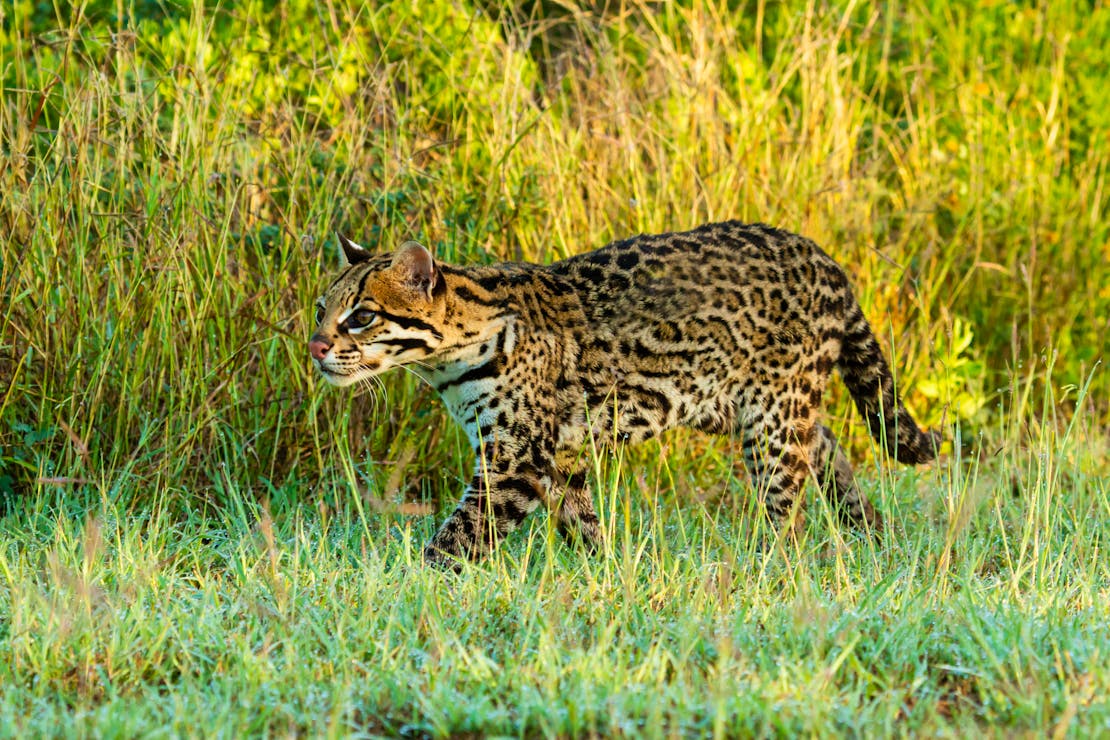
The ocelot is one of the rarest wild cats in the U.S. There are fewer than 100 individuals surviving in two small, isolated populations in South Texas. They depend on dense, low-elevation thornforest habitat in the Rio Grande Valley, staying close to thick brush cover rather than mountains. These cats also appear in Arizona, using the same habitat corridors as jaguars.
Jaguars historically ranged into the mountainous "Sky Islands" of central Arizona and New Mexico. These cats were driven out of the U.S. by the mid-20th century. Today, only occasional wandering males cross north from Mexico into Arizona to utilize the rugged, mountainous borderlands.
The jaguarundi is considered extirpated from the southernmost regions of Texas, New Mexico, Arizona and California. There are no confirmed resident population remaining in the U.S. They used to be found in the dense thornscrub of the Lower Rio Grande Valley.

How can you tell the different types of wild cats apart?
With five very different-looking cats sharing the same corner of the country, here are three key features to tell them apart:
1. Coat pattern:
- Bobcats have spots and streaks on a tan-to-brown coat
- Ocelots have bold, black-outlined "chain rosette" markings
- Jaguars have larger rosette spots, often with a dot in the center
- Mountain lions have a solid tawny coat with no spots as adults
- Jaguarundis have a completely solid, unmarked coat

2. Build:
- Bobcats have a stocky, medium build, roughly twice the size of a house cat, with longer legs
- Ocelots are sleek and muscular, similar in length to a bobcat but lower to the ground
- Jaguars are the largest and most powerfully built cat in the Americas, with a heavy, muscular frame
- Mountain lions have a long, lean, athletic body built for powerful leaps and bursts of speed
- Jaguarundis have a small, elongated body with short legs and a long, low-slung silhouette, earning them the nickname "otter cat"
3. Tails:
- Bobcats are named for their short, "bobbed" tails with a black tip
- Ocelots have long, ringed tails
- Jaguars have shorter, spotted tails
- Mountain lions have long tails with a dark tip
- Jaguarundis have very long, solid-colored tails

Is there a striped wild cat in Texas with a long tail?
If you spotted a slender animal in the woods with a long, black-and-white ringed tail, big round eyes and pointed ears, you likely met a ringtail.

Let’s bust a common myth: despite its nickname, the "ringtail cat" is not a cat at all! It is actually a member of the raccoon family, more closely related to coatis than to any wild cat.
So, what is an actual cat with a long tail? A jaguarundi! Jaguarundis do not have striped tails. Instead, their coats are a solid, uniform color, ranging from grayish to reddish-brown.

What do these cats eat?
All five cats are carnivores, but their menus vary with their size and habitat.
- Bobcats primarily hunt rabbits and hares, supplementing their diet with rodents, birds and, occasionally, young deer.
- Ocelots are nimble, opportunistic hunters of small mammals, birds, reptiles and fish.
- Jaguars are powerful, opportunistic hunters with one of the strongest bites of any cat. They prey on everything from peccaries and deer to reptiles and fish.
- Mountain lions are built to take down large prey, with deer as their primary food source across most of their range.
- Jaguarundis hunt rodents, birds and reptiles often during the day. They are more diurnal than most cats!

As predators, each of these cats help keep prey populations in balance. This then protects the plants and habitats those animals rely on. A landscape that can support healthy wild cat populations is a landscape that is healthy from the ground up.
What are the biggest threats to these cats?
Development is the biggest overall threat facing our wild cats. As roads, agriculture, urban growth and industrial infrastructure spread across the borderlands, the habitat and wildlife corridors these cats depend on are shrinking and becoming disconnected.

Mining development encroaches on the rugged "Sky Island" mountain ranges in Arizona threatening some of the last remaining jaguar habitat in the region. Thornforest habitat ocelots depend on in South Texas is increasingly fractured and lost to oil and gas infrastructure and other industrial development, including SpaceX's experimental launch operations along the Gulf Coast. Barriers along the U.S.-Mexico border, including border wall construction, add to this fragmentation by cutting off many wild cats from the larger, more genetically diverse populations in Mexico.
Vehicle strikes are also a leading cause of death as cats are forced to cross roads to move between fragmented habitat patches.

Other threats include unintentional poisoning from rodenticides, historical hunting and trapping, and the low genetic diversity that comes with small, isolated populations like the U.S. ocelot population.
How you can help wild cats in the U.S. and beyond!
When we celebrate and protect our wild cats, we are protecting the entire web of life they are woven into.

- Drive with wildlife in mind. Slow down and stay alert in areas where wild cats are known to roam, especially at dawn, dusk and at night.
- Speak up for habitat and connectivity. Support policies that protect and reconnect the habitat corridors.
- Choose wildlife-friendly practices at home. Use poison-free rodent control. If you hunt, choose lead-free ammunition.
- Share their story. Many people do not realize some of these cats call the U.S. home. Help spread the word about these remarkable animals and why they are worth protecting.
- Support Defenders of Wildlife's work. We are working to raise awareness and advocate for stronger endangered species protections and community-based, non-lethal tools that help people and cats coexist.
With more awareness — and a lot more habitat protection — these remarkable cats can continue to roam the wild landscapes of the borderlands for generations to come.