This blog was written by Defenders of Wildlife Southeast Stanback Fellow Sally Watanabe.
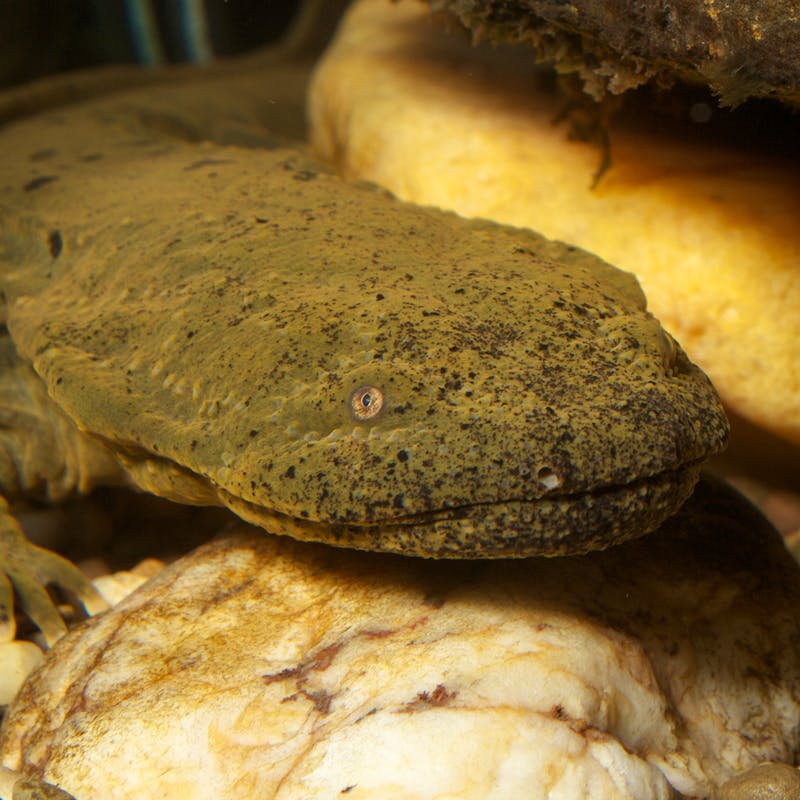
The mature forests of the Appalachian Mountains slope into watersheds where North America’s largest amphibian — the Eastern hellbender — lives. You’d be lucky to ever see one of these salamanders, which can reach up to 30 inches long, as they often live under the shelter of large river rocks.

Looking nearly as ancient as the mountains, the Eastern hellbender (Cryptobranchus alleganiensis alleganiensis) has not evolved much over the past 160 million years and is still found in pristine streams today. I had the privilege to see one in June during a field excursion to Pisgah National Forest in Western North Carolina.
Believe me when I tell you, this unusually large, oddly plump creature with a flat head and tiny eyes captivated the hearts of all in attendance. Hellbenders haven’t, however, always evoked the same awe and curiosity.

Why is it called a hellbender?
While no one knows exactly how hellbenders got their name, one theory is their unusual appearance – a slimy coat, strange proportions and folded skin – which caused some to think they came from the underworld and were hell-bent on returning. They were often described as revolting or thought of as a symbol of sin.
Another theory is based on the way males fight during breeding season, hooking onto each other by biting and thrashing around. Additional names include the devil dog, snot otter, lasagna lizard, mud devil or Alleghany alligator.
Not all names for this animal are negative, though. The Cherokee, whose ancestral land includes all Western North Carolina, call this animal “tsuwa,” which translates to “water dog.”

The tsuwa plays a significant role in Cherokee culture where non-human beings are viewed as our relatives with their own rights to protection and existence. In a legal framework, this has been adopted as “Rights of Nature” where natural and cultural resources are protected by granting them legal rights.
Are hellbenders dangerous to people?
Hellbenders are not dangerous to people!
Widespread misconceptions about this animal through Western society from the 1800’s to mid 1900’s led to it being killed on sight by many. People mistakenly believed they were venomous, because the slime secreted on their skin when stressed can be a mild skin irritant.
Many also believed hellbenders were destructive to fish populations, eating trout and competing with fishermen. While it was common to cut fishing lines that caught hellbenders to passively let them die instead of releasing them, some fishermen took more intensive measures to make sure the animal was killed.

In the 20th century, hellbenders had a rough time in the media. An Illinois newspaper described them as “hideous enough to suggest all sorts of horrid dreams and nightmares.” One article published in 1912 in the Pittsburgh Post, detailed the “thousands of pests” in the river and advised beheading and burying hellbenders as the only way to ensure they don’t survive. A1939 Pennsylvania Angler paper noted the Clinton Sportsmen Association was offering a monetary reward for capturing hellbenders and more than 400 were found and killed in efforts to improve fishing conditions.
What influenced social perceptions of hellbenders?
A comprehensive media analysis from 1850 through 2016 showed public perception around hellbenders began to shift around the 1980s. This happens to coincide with the Conservation Biology Era, a trend in recent decades where information about species decline is supported by recommendations for restoration and protection.
A combination of education, research and outreach helped shift the narrative of the hellbender from loathed to loved. The misinformation was corrected. Society transitioned away from exploitation attitudes and towards an understanding of how these salamanders are ecologically important.
Why are hellbenders important to our environment?
Because adult hellbenders breathe entirely through their skin, they are extremely sensitive to pollution and sedimentation, which makes them a key indicator of water quality. Places that support hellbender populations also support many other species.

Names like “snot otter” are also helpful in changing the perception of the animal from harmful to harmless. You’ll see hellbenders revered on t-shirts, in music and on murals all over Appalachia today.
What are current threats to hellbenders?
While killing these animals may not be as common today, they still need our help! Hellbenders are most impacted by the degradation of their habitat through pollution, sedimentation and loss of suitable nest rock habitat. Compared to its population range in historic times, only 6% of those original populations are expected to have healthy hellbenders.
Threats to hellbenders were exacerbated by the impacts of Hurricane Helene in 2024 throughout Western North Carolina, especially the debris removal process. Heavy machinery crushed nest rocks, bulldozed rocks up the banks and pulled logs and trees out of the banks that provided important habitat for hellbenders and their prey. Hellbenders, however, have proved to be incredibly resilient. Even in the face of anthropogenic impacts and natural disasters, populations are surviving.

How can we protect hellbenders?
The hellbender was proposed for listing under the Endangered Species Act in 2024, but the ruling has been delayed due to challenges with the Trump administration’s staffing and budget cuts. Defenders of Wildlife is still pushing to have this species listed.
You can help protect hellbenders — tsuwa — by sharing their ecology and importance, dispelling misinformation and advocating for their protection and right to exist, slime and all.
The hellbender is a living testament to the resilience of Appalachia, and now it’s up to us to stand up for this relative.