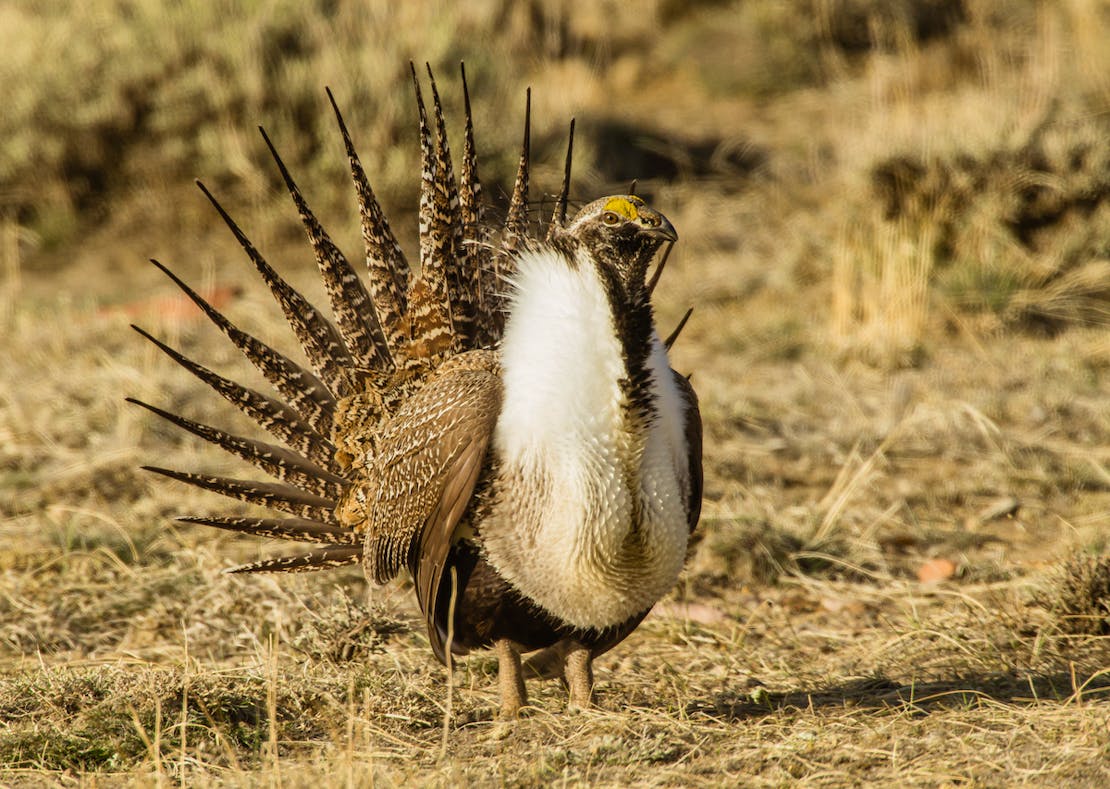
The Greater sage-grouse is one of the most iconic birds of the American West. Each spring, males gather on breeding grounds called “leks,” where they inflate their bright yellow air sacs and fan their spiky tail feathers in a courtship display found nowhere else on Earth. But this iconic performance is playing out to a shrinking audience.
Sage-grouse populations have declined an estimated 80% since 1965, with nearly half of that loss occurring since 2002. In July 2025, wildlife officials confirmed that the species had disappeared entirely from North Dakota, a stark reminder that local extinctions are no longer hypothetical but real.
Sage-grouse depend on vast and unbroken expanses of sagebrush steppe, an ecosystem that once covered much of the interior West. Aficionados refer to this habitat as the Sagebrush Sea because it can resemble blue-green waves undulating across the horizon. Today, less than 14% of the habitat remains intact enough to sustain healthy sage-grouse populations. One significant driver of that loss is accelerating oil and gas development on public lands, which is occurring at exactly the moment the species can least afford it.

Why Sage-grouse Need Intact Sagebrush Habitat
Sage-grouse are sagebrush obligates, meaning they cannot survive without this specific habitat type. They nest beneath sagebrush canopy, feed almost exclusively on sagebrush leaves through the winter and rely on undisturbed leks for breeding.
Two key facets of sage-grouse ecology to keep in mind
1. They rely on a healthy, connected matrix of different habitat areas within the sagebrush ecosystem:
- Open low knolls for their springtime lekking displays and mating activities;
- Nearby nesting habitats characterized by a mix of sagebrush and grasses that provide cover near moister areas like wet meadows or creeks and food for nests and young, and
- Winter habitats of tall sagebrush in places with less snow accumulation where they can shelter and feed on exposed plants.

These distinct seasonal requirements mean that large areas of sagebrush habitat are necessary to create the matrix of food and cover the birds require.
2. Sage-grouse are very sensitive to human disturbance, avoiding:
- Urban areas,
- Busy roads,
- Power lines and
- Other infrastructure that provide roosting sites for predatory raptors such as eagles and hawks.
Conservation Delayed and Denied
With so many human activities posing threats to the sage-grouse, it should come as no surprise that populations are declining and efforts to conserve them have faced major headwinds from economic interests.

While conservation groups have sought Endangered Species Act protections for the species since 2003, the Greater sage grouse remains unlisted and its populations continue to decline. In 2015, the Bureau of Land Management published a set of plans that identified “priority” sage-grouse habitats for increased protections, though the plans did not go far enough to fully protect sage-grouse habitat from oil and gas drilling, livestock grazing and other surface-disturbing activities.
Nonetheless, the U.S. Fish and Wildlife Service determined that the plan measures were sufficient to preclude the need for ESA listing. Now, BLM is retreating from even those modest sage-grouse conservation measures and promoting the rapid expansion of oil and gas development in important sage grouse habitat. To make matters worse, Congress annually prohibits FWS from using funds to list the greater sage-grouse under the ESA, even as populations continue to decline.

Oil and Gas Development: Fragmenting the Sagebrush Sea
Oil and gas development brings to the landscape numerous features that fragment sagebrush habitat and displace birds and nests — access roads, well pads, drills, pipelines, lighting and noise. Multiple studies confirm oil and gas activities harm sage-grouse – declines in lek attendance have been observed with as little as one oil well pad per square mile, and leks are virtually eliminated from landscapes with >6.5 well pads per square mile.
Additionally, research has shown that the likelihood of nest success and chick survival declined as consistent disturbance associated with energy development increased. That's why scientists recommend keeping this kind of activity at least 3 to 5 miles away from leks — buffers of this size protect most, though not all, of the habitat sage-grouse rely on for nesting and raising young.
Across their range, sage-grouse are contending with a U.S. energy policy that is poised to do tremendous damage to the birds and their habitats. The Trump administration came into office promoting an agenda of “Energy Dominance,” which has in practice meant facilitating more oil and gas drilling, in more places and with fewer protections for wildlife and landscapes. Part of that threat comes from changes to the leasing process put in place by the July 2025 One Big Beautiful Bill Act, which mandated that BLM offer much more acreage for oil and gas leasing, and removed some of the agency’s discretion to avoid leasing in important wildlife areas.
The next hit came in December 2025, when BLM issued a new set of sage-grouse plans that rolled back key protections – eliminating prioritization of oil and gas leasing outside of important sage-grouse habitats, allowing drilling activities as close as one-quarter mile from leks and weakening requirements to change management if populations continue to decline. Piling on, BLM has proposed a new regulation to further weaken its oil and gas regulations which could roll back requirements to reduce conflict between oil and gas development and other public land uses and weaken financial assurances that ensure companies clean up after their drilling operations and plug leaks that spew greenhouse gas emissions.
The agency responsible for protecting sage-grouse habitat in the American West has instead thrown open the doors to let oil and gas companies trample it. As one example, Wyoming holds nearly 40% of remaining sage-grouse habitat in the U.S., and it is also ground zero for energy leasing on public land. Acreage being offered for oil and gas lease sales in Wyoming’s sage-grouse habitat is skyrocketing-- 190,000 acres in 2025 and nearly 600,000 acres in 2026 — and BLM is currently considering offering over 400,000 acres in sage grouse habitat in a single sale next March! Together, that’s an area the size of Delaware!
What's at stake for sage-grouse habitat

Oil and gas development is not a new pressure on the Sagebrush Sea, but the pace and scale of development is accelerating just as the policies meant to manage it are weakening. More than two decades after the sage grouse was first identified as imperiled, it still lacks the protections it needs, and we must let science, not drilling schedules, determine the future of the species and the Sagebrush Sea.
Author

Aimee Delach