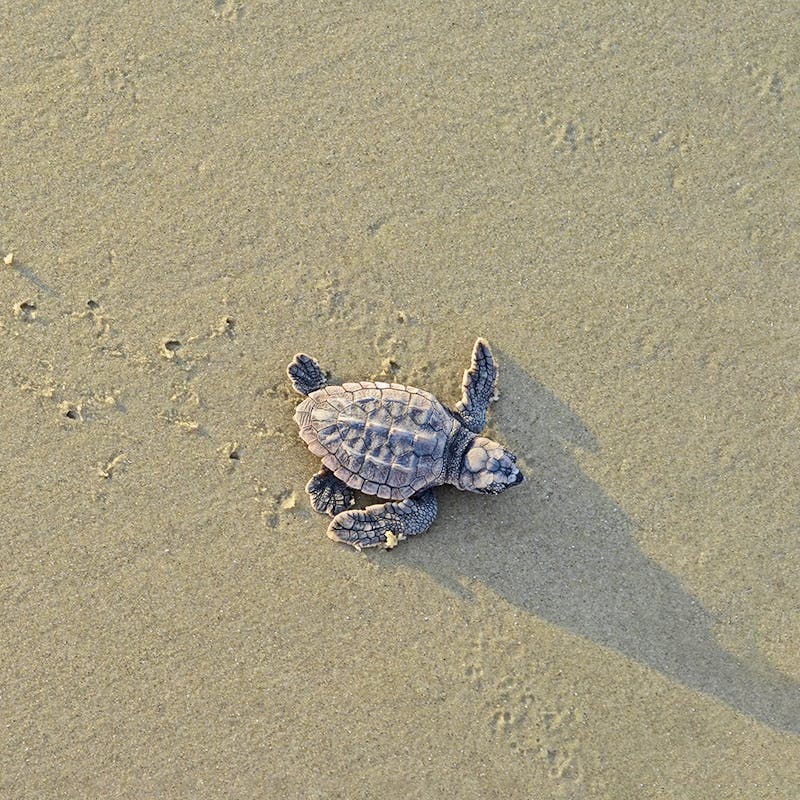
Caretta caretta, or the loggerhead, is one of the seven sea turtles in the world. Along with leatherback, hawksbill, Kemp’s ridley, olive ridley and green sea turtles, loggerheads can be found off the coast and utilizing United States beaches.

A key way to identify a loggerhead sea turtle is by their large head and heart-shaped reddish-brown hard shell, or carapace. One of these physical features is why this turtle is called a loggerhead. Read on to learn which and other cool facts about loggerhead turtles!
Why are these turtles called loggerheads?
The loggerhead’s moniker is so called because of the animal’s large, block-shaped head.

While the historical context of the term “loggerhead” implies the bearer is thick-headed or not particularly smart, these turtles are well built for their diet and ocean life. Loggerhead sea turtles have powerful jaws allowing them to easily crush their hard-shelled prey.
Sea turtles are also thought to have great memory as they are exceptional navigators. They often migrate thousands of miles from their feeding grounds to the beaches where they were born to nest.

What do loggerhead turtles eat?
Loggerhead turtles primarily eat crustaceans, like crabs and mollusks, like conchs. They also occasionally will eat jellyfish or fish.
After eating, these turtles often leave fragments of their prey’s calcium-rich shell behind. Other marine animals, from urchins to sea snails, may break down or consume these remnants to utilize the calcium to grow their own shells or exoskeletons. Other pieces may be broken down and mixed with the sand, speeding up nutrient recycling in benthic or ocean bottom systems.
These diet and eating habits contribute to loggerhead sea turtles being called a keystone species. Another important way they contribute to maintaining a healthy ocean is by providing habitat for about 100 different animals and plants who ride on the turtles’ back. These hitchhikers include algae, crabs, barnacles and small worms. In a way, these turtles are like a mobile ecosystem all by themselves!

How long do loggerhead turtles live?
Loggerhead turtles, as well as other sea turtles, can live well over 50 years in the wild. Because scientists are still learning about how these animals live in the ocean – where they spend most of their life – more precise lifespans are unknown.
We do know sea turtles take a long time to mature though. Loggerhead sea turtles reach sexual maturity around 30 years old.
Where do loggerhead sea turtles live?
Sea turtles spend different parts of their lives in various areas across the globe, but most of their lives are in the ocean. Loggerhead sea turtles are found in subtropical and temperate waters, including the Atlantic, Pacific and Indian Oceans, as well as the Mediterranean Sea.

Their nesting beaches are often the exact same beach where they were born. U.S. beaches are particularly important for loggerhead sea turtles. North Carolia to Florida’s Atlantic coast beaches support the largest aggregation of nesting loggerhead sea turtles in the world, with Florida being the number one nesting area for loggerheads globally. The majority of these turtles’ nest at Archie Carr National Wildlife Refuge in Florida.
Most sea turtles, including loggerheads, undergo long migrations — as far as 1,400 miles! — between their feeding grounds and nesting beaches. Scientists believe these beloved animals use the Earth’s magnetic field to help them navigate across the oceans.

How rare are loggerhead sea turtles?
Populations of any sea turtle are extremely difficult to count because most male and juvenile turtles do not return to shore once they reach the ocean as hatchlings. We do know, however, loggerheads are in trouble and populations across the globe face many threats.
Are Caretta turtles endangered?
Yes, Caretta caretta is listed under the U.S. Endangered Species Act. The worldwide population is listed as threatened, but five of the nine distinct population segments are listed as endangered.

What is a turtle’s biggest enemy?
The sea turtle’s biggest enemy is humans. Sea turtles are often caught in fishing nets and gear. Developments are overtaking their important beach habitats and human waste, like plastic, pollutes their ocean home.
Artificial lighting is also a huge problem for nesting female and baby sea turtles. These beloved animals use the brightest horizon to orient themselves. The brightest natural light comes from reflection of the moon and stars over the water, leading them to the ocean. Artificial lights, however, confuse the animals and lead them further onto land.

If a sea turtle becomes stranded, its chance of survival diminishes. Adults may be hit by vehicles or become dehydrated. Hatchlings are more likely to fall prey to birds, crabs and other predators.
You can be a hero for sea turtles!
We don’t need to be enemies of these beloved animals. Instead, let’s choose to be heroes and help them.
Whether you are visiting or reside by the beach, turn out your lights at night, especially those visible from the beach. Make sure you follow posted signs to stay away from nesting areas and do not litter. You can also take things a step further by joining a beach cleanup. Keeping our beaches clean helps prevent obstacles and entanglements for nesting and hatchling sea turtles.
It’s also important to remember the waste on the sand or in rivers and creeks eventually makes it to our oceans. This is why it’s also important to reduce the amount of waste you produce wherever you go!
Author

Allison Cook