Join our mobile Rapid Response Network!
You can be the first to hear about how we’re going to hold this administration accountable and how you can fight back for wildlife!
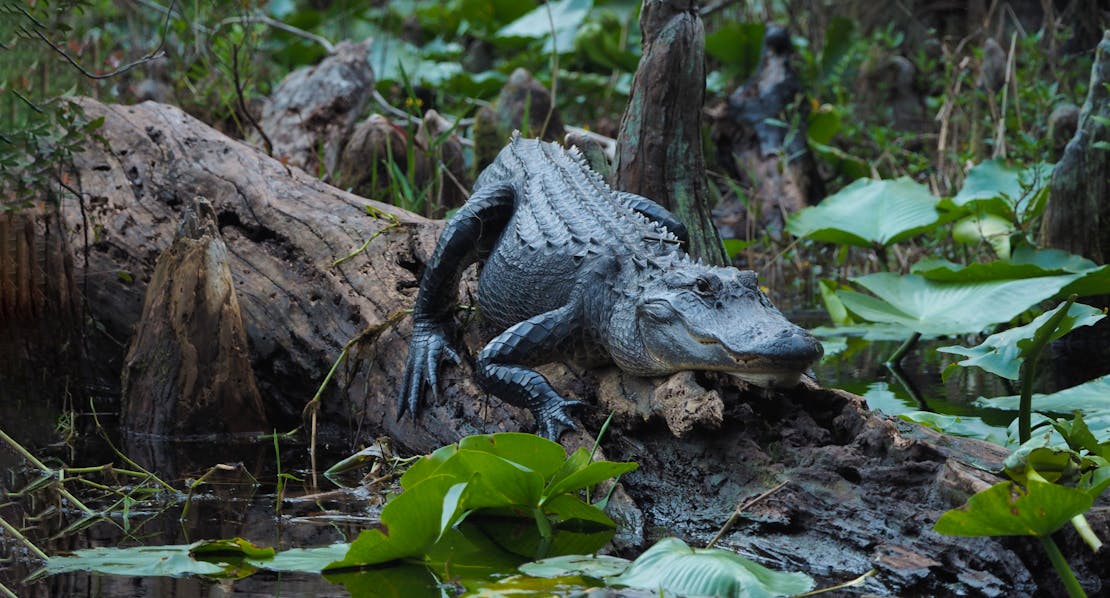
Alligators vs Crocodiles? There are a few visible differences between alligators and crocodiles.
Crocodiles have slender snouts, while alligators’ are broader. When their mouths are closed, the large, fourth tooth in the lower jaw is visible on crocodiles. On alligators, the tooth fits into a socket in the upper jaw and is not visible.
American alligators use their powerful tails to propel themselves through water. While they move very quickly in water, they are generally slow-moving on land. They can, however, move quickly for short distances.
Alligators are a keystone species benefiting the marshes, swamps, rivers and lakes where they live and many other species found within their natural community.
Are American alligators and American crocodiles endangered?
The American alligator is a stunning example of a species that has fully recovered in large part due to protections provided by the Endangered Species Act. By conserving habitat and strictly controlling hunting and trade, we have been able to increase the population to the point where sustainable harvest programs provide economic incentives to conserve alligators and their aquatic habitats.
Despite its recovery, the American alligator is still listed as threatened under the ESA, due to its similarity of appearance to the American crocodile which is also listed as threatened. Since 1975, the American crocodile’s numbers have increased from less than 300 to more than 2,000 adults. People are increasingly encountering crocodiles as a result of their recovery and the growing number of people living and recreating in south Florida.
To avoid conflict situations, never feed alligators or crocodiles, always keep a safe distance, only swim in designated swimming areas during daylight hours, and keep pets on a leash and away from the water.
Loss of habitat to human development, illegal killing and roadkill are the greatest threats to American alligators and American crocodiles. As sea level rises due to climate change, a significant portion of freshwater habitats may face saltwater incursion or inundation.
The American crocodile is threatened in the U.S., endangered elsewhere.
The American alligator is listed due to similarity of appearance to the American crocodile.
American alligator
American crocodile
Defenders' Impact
Defenders fights to defend the ESA, which was vital in bringing the alligator back from the brink of extinction, and the Clean Water Act, which protects wetlands and waterways that are important for alligators and crocodiles.
We also work to protect these animals’ habitat through partnering on Everglades restoration and other habitat conservation initiatives, protecting national wildlife refuges and national parks, and engaging in state-level environmental planning. Defenders additionally works on the ground, providing information on how people can share the landscape responsibly with wildlife.
What You Can Do
Help fight climate change by reducing emissions. Support Defenders work in protecting the ESA. Speak up for habitat protections, especially for areas vulnerable because of climate change and sea level rise. Keep alligators, crocodiles, you and your loved ones safe by keeping a safe distance from wildlife, only swimming in designated swimming areas during daylight hours, never feeding wildlife, and keeping your pets on a leash and away from the water.

About
South Florida is the only place where you can find both crocodiles and alligators.
American alligators occur in Florida, southern Texas, Louisiana and parts of North and South Carolina, Georgia and Alabama, with the alligator’s range appearing to inch northward in the last few years. American crocodiles are found in southern Florida, the Caribbean, southern Mexico and along the Central American coast south to Venezuela. Both are found in freshwater wetland areas.
An estimated 5 million American alligators are spread out across the southeastern United States. Roughly 1.25 million alligators live in the state of Florida. There are more than 1,000 American crocodiles, not including hatchlings, in Florida.
Large male alligators are solitary, territorial animals. The largest males and females will defend prime territory. Smaller alligators can often be found in large numbers in close proximity to each other, because smaller alligators have a higher tolerance of other alligators within a similar size class. Decidedly less aggressive than the infamous Nile and Australian crocodiles, American crocodiles are shy, reclusive and rarely seen by people.
Female crocodiles will build a nest of loose dirt in a mound by the water's edge in April or May. She then lays and buries the eggs and fiercely guards her nest. When the eggs hatch in July or early August, she will carry her young to the water. But, unlike alligators, crocodiles will not continue to care for their young.
Alligator eggs generally hatch in mid-August. Sex is temperature-determined, like sea turtles, based on the temperature of egg incubation, with temperatures of 86°F producing females, and 93°F yielding males.
Mating Season: Crocodiles: January and February; Alligators: Mid-April through May
Egg Incubation: Crocodiles: 2 to 3 months; Alligators: 60 to 65 days
Clutch size: Crocodiles: 35 to 50 eggs; Alligators: 20 to 50 eggs
Alligators and crocodiles eat fish, turtles, various mammals, birds and other reptiles.
Featured

Why We Almost Said “See You Later” to the American Alligator
Read some amazing alligator anecdotes and fast facts.
Publications
Read More About the American Crocodile and American Alligator
News