Join our mobile Rapid Response Network!
You can be the first to hear about how we’re going to hold this administration accountable and how you can fight back for wildlife!
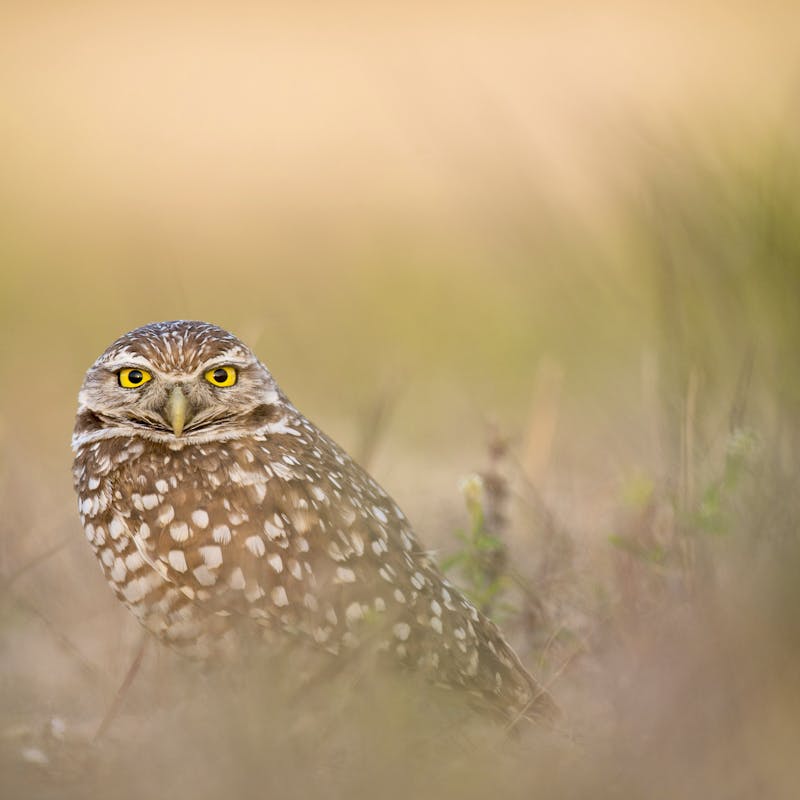
Burrowing owls are one of the smallest owls in North America.
They are named so because they live underground in burrows that have been dug out by small mammals like ground squirrels, prairie dogs and desert tortoises. Some, like populations in Florida, may dig their own owl home as the soil is soft enough.
Why are burrowing owls imperiled?
Burrowing owls were once found in nearly every arid open landscape from the United States-Canadian border through South America. Today, populations are under increasing pressure from habitat destruction and land use change.
Burrowing owls are not currently protected under federal law. They are listed under several state laws, including as endangered in Minnesota, threatened in Colorado and Florida. They also have interim protections under the California state Endangered Species Act as candidates for permanent protections. Therefore, outside of California, nothing is requiring land developers to protect these owls’ habitat, so this vulnerable species will continue to decline.
Habitat destruction, land use change and ground squirrel eradication.
Only listed as an endangered species in Canada but not federally the U.S.
Listed under several states as endangered, threatened or a species of concern. They are a candidate for listing as threatened or endangered under the California ESA.

Defenders' Impact
Defenders of Wildlife is working to secure stronger legal protections for burrowing owls, whose populations have experienced significant long-term declines due to habitat loss, urban expansion and inconsistent conservation practices. Defenders is one of the co-petitioners in the ongoing effort to list the burrowing owl as threatened or endangered under the California ESA, a critical step toward establishing enforceable habitat protections at the state level.
Defenders works to ensure land use decisions, infrastructure projects and development activities account for burrowing owl habitat and we advocate for science-based protections on a project-by-project basis. We also engage in broader land use and energy planning processes to make sure burrowing owl conservation is built into decisions before harm occurs, rather than addressed after the fact.
Defenders also is protecting burrowing owls across the Great Plains, where we work to conserve prairie dogs. Active prairie dog burrows are crucial to bolstering owl populations, as well as for endangered black-footed ferrets. For burrowing owl reintroduction, the required active prairie dog acres depend on density. In Colorado, for example, we need 16 prairie dogs per acre, as followed by Colorado Parks and Wildlife. It is also important to have large, contiguous colonies for successful owl habitat. Our fieldwork involves mapping prairie dog colonies and density.
What You Can Do
Advocate for the protection of habitat. Help fight climate change.

About
Burrowing owls were once found in nearly every arid open landscape from the U.S.-Canadian border through South America. Today, they are still found in areas of South America, northern Mexico, Florida, the Caribbean and southwest U.S.
In California, burrowing owls are concentrated in the Imperial Valley, with declining populations throughout much of the state including the Central Valley, Southwestern California and the San Francisco Bay Area.
Their preferred habitats are flat, treeless areas with low-growing vegetation.
Estimates are fewer than 10,000 breeding pairs of burrowing owls.
Burrowing owls typically live in colonies.
These owls are ground-dwellers and usually take over burrows excavated by badgers, ground squirrels, prairie dogs or other burrowing animals. Some, like populations in Florida, may dig their own owl home as the soil is soft enough.
Burrowing owlets will mimic the sound of a rattlesnake to scare off predators.
During nesting season, adult males will find burrows near the mother birds, creating a border to defend against predators or other burrowing owls. Both parents will take care of the eggs and young.
Mating season: April
Gestation: 4 weeks
Clutch size: 5 to 9 eggs
Owls eat smaller birds, rodents and other small mammals, snakes and other reptiles, and insects.
Publications
Read More About the Burrowing Owls
News