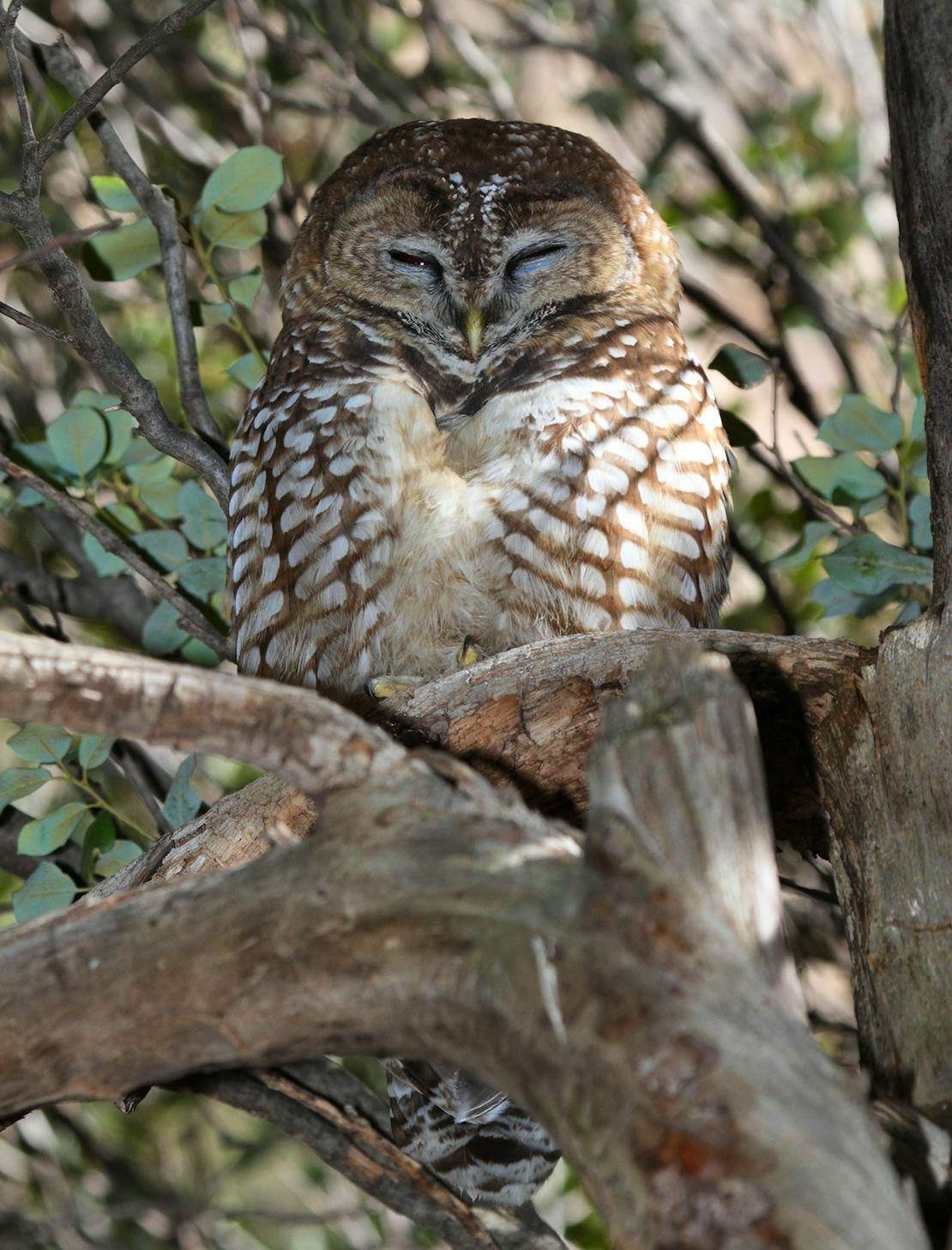
Spotted owls are medium-sized, brown owls with round or oval white spots on their head, neck, back and chest.
These owls are dependent on old-growth forests with large trees and plenty of shade. There are three subspecies. Northern spotted owls are the largest and darkest subspecies, and are found in the Pacific Northwest. The California spotted owl is only found in California. The smallest and lightest colored subspecies is the Mexican spotted owl, found in the Southwestern United States and south into Mexico.
Why are spotted owls imperiled?
Spotted owls are imperiled by habitat loss and logging, climate-driven wildlife impacts and competition with increasing barred owl populations. Extensive logging of old-growth forests removed and fragmented spotted owl habitat. The conversion of forests continues to threaten all three subspecies.
Habitat destruction, land use change, climate change impacts and invasive species threaten spotted owls.
Northern and Mexican spotted owls are federally listed as threatened.
California spotted owls are proposed for federal listing. The Coastal-Southern California distinct population segment is proposed as endangered, and the Sierra Nevada distinct population segment is proposed as threatened.
Defenders' Impact
Defenders works to protect all three subspecies of spotted owl by engaging in plans that would impair their essential habitat. Spotted owl habitat is found in only certain locations where there are large, old trees; downed wood; layers of forest canopy; and often large, dead trees known as snags.
What You Can Do
Protect habitat and help fight climate change.

About
Spotted owls live in old-growth forests. The northern spotted owl subspecies are found in the Pacific Northwest, California spotted owls are only found in California and Mexican spotted owls are found in areas of Arizona, New Mexico, Colorado, Utah and south into Mexico.
The Mexican spotted owl is unique because it nests in both old forests and rocky canyon habitats.
There are approximately 1,200 pairs of northern spotted owls in Oregon, 560 pairs in northern California and 500 pairs in Washington state. Some northern spotted owl populations are declining by as much as 9% every year.
California spotted owl population numbers are unknown, but a 2021 estimate placed the Sierra Nevada population around 2,200 to 2,300. An occupancy trend data from 2021-2024 indicates a 2% annual decline.
Mexican spotted owl population trends remain unclear, but the numbers are very low, likely less than 2,000. There are over 1,300 known nest sites in the U.S. and fewer than 50 known sites in Mexico.
Spotted owls are nocturnal, most active at night. Spotted owls are very territorial and will use hoots, barks and sharp whistles to defend their best foraging habitat.
Spotted owls are monogamous and form long-term bonds. While spotted owls are mobile, they tend to use the same nest site year after year. Males provide food for nesting females, while females do all the brooding of young owls.
Mating season: March to April
Incubation: Approximately 30 days
Clutch size: One to four eggs, with an average of two eggs
Owls eat smaller birds, rodents and other small mammals, snakes and other reptiles, and insects. Northern spotted owls have a narrower diet, primarily eating flying squirrels, woodrats and tree voles.
Read More About the Spotted Owls
News