
Join our mobile Rapid Response Network!
You can be the first to hear about how we’re going to hold this administration accountable and how you can fight back for wildlife!
Eastern indigo snakes (Drymarchon couperi) are the longest native snakes found in North America.
They possess shiny scales that have glossy, dark bluish-black color which casts iridescent blue or even purple in bright light, making them visually unique and captivating.
Today there are over 3,000 species of snakes, all of which belong to the Squamata order with the animal they evolved from: lizards.
These limbless reptiles play a vital role in their ecosystems as predators by helping control rodent and other prey populations. Eastern indigo snakes are particularly significant as apex predators who eat other snakes, including venomous ones.
What threats do Eastern indigo and other snakes face?
Habitat loss is one of the greatest threats to threatened snakes in the United States, which include the Eastern indigo, giant garter (Thamnophis gigas), and southern hognose snake (Heterodon simus). Road mortality, historic over-collection and sea level rise are also threats to snakes.
Indigo snakes lose more than 5% of their habitat each year in Florida due to urban development. Habitat fragmentation from increased housing and road development separates habitat into smaller patches that cannot support populations.
One key piece of habitat these snakes, as well as over 360 other species of wildlife, depend on for shelter is gopher tortoise burrows, primarily in longleaf pine habitat. Land developers also sought and built on this habitat for decades leaving only 3% or less than 3 million acres, unscathed by the 1990s.
Restoring and conserving longleaf pine habitat in the Southeastern U.S. is inseparably linked to saving eastern indigo snakes.
Key ring-necked snake
Eastern indigo snake, giant garter snake and Louisiana pine snake
Eastern indigo snake
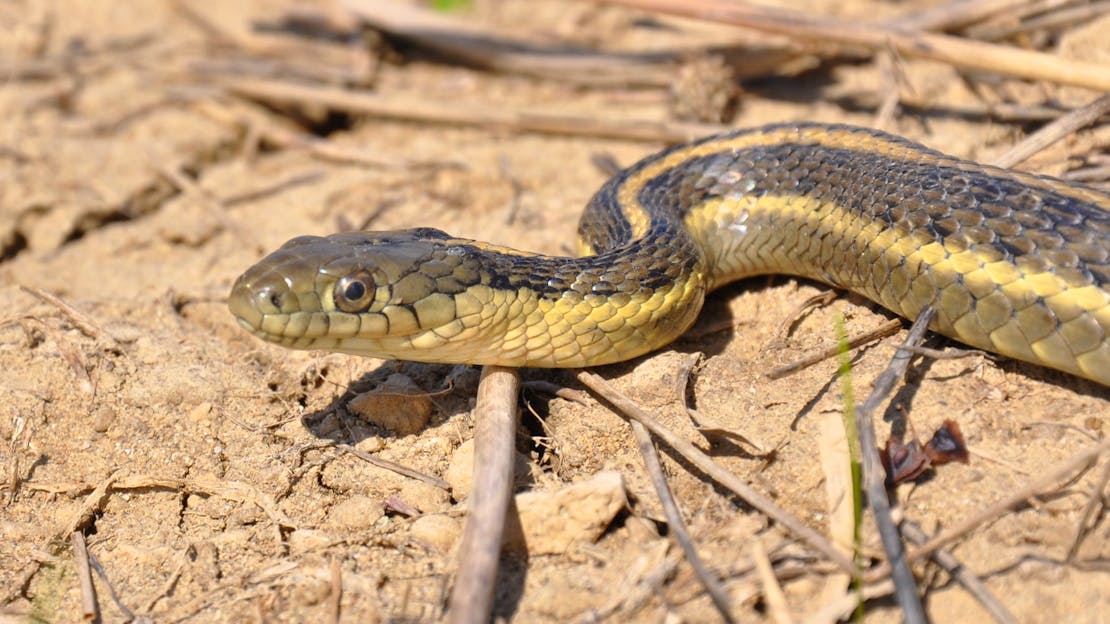
Giant garter snake
Louisiana pine snake

Defenders' Impact
Defending habitat is extraordinarily important for all snakes and we are working across the country to protect lands that are home to these snakes.
Defenders of Wildlife’s Smart from the Start program encourages responsible renewable energy siting that will protect habitat for wildlife. Defenders works to protect habitat in Florida through our place on the Florida Gopher Tortoise Technical Advisory Group and we actively support the Florida Wildlife Corridor and land conservation funding initiatives across the Southeast.
What You Can Do
Learn about the different kinds of snakes in your area and recognize the difference between venomous vs non-venomous. If you have an issue with snakes in your yard, call your local wildlife agency for help and do not attempt to harm the animals yourself.
Snakes, like eastern indigo, need the strong protections afforded to them by the Endangered Species Act and Clean Water Act so speak up in support of bedrock environmental laws.
Always verify pets are sourced responsibly and never release a pet into the wild if they can no longer be cared for.

About
Snakes are found everywhere except Antarctica, Iceland, Ireland, Greenland and New Zealand. Biodiversity of snakes is concentrated in the tropics, but they are found in many habitats including in the water, forests, deserts and prairies.
The eastern indigo snake was historically found throughout Florida and in the coastal plain of Georgia, Alabama and Mississippi. Today they live in a limited portion of Florida and southern Georgia and Alabama.
Giant garter snakes thrive solely in California’s critical wetlands. Only about 5% to 10% of their historical wetland acreage remains.
Snake population numbers vary by species, but many, including Eastern indigo, are declining due to shrinking habitat.
Often observed flicking their tongues, snakes use their forked tongue to smell the air.
Snakes are ectotherms, meaning they must regulate their body temperature externally by sunning themselves or retreating to cool, shaded areas. They are most active in warmer months and many hibernate in winter.
Eastern indigo snakes retreat into gopher tortoise burrows and other cavities.
Giant garter snakes are the most aquatic garter snake and can be seen swimming in natural wetlands like marshes, sloughs, ponds and small lakes and streams, as well as artificial waterways and agricultural wetlands.
Mating for these species generally occurs during the colder months or at the end of dormancy, with eggs being laid in the late spring or early summer. Giant garter snakes are one of the few species that give birth to live young (ranging from 10 to 46 young).
All snakes are carnivores, but their diet varies depending on the species. Most, and all native to the U.S., consume smaller prey like insects and other invertebrates, rodents, birds, frogs, eggs and other reptiles.
News


