Conservation is often associated with a scientist trekking through a rugged landscape, holding a notebook or getting up close to a wild animal. The term may also accompany a U.S. president standing before high, rocky walls and a waterfall (Theodore Roosevelt, anyone?), or a politician signing a new park, refuge or wildlife protection bill into place. All of these conservationists are important, but they are not the only ones to advocate for the protection of our beloved wild animals and wild places. Some conservationists are more artful in how they inspire others to care, speak up and act on behalf of wildlife and the environment.
Let’s learn about these five talented conservationists who you may not know but absolutely should. They may even inspire you to become a conservationist using your own skills!

1. Ansel Adams
When it comes to photography of our National Parks and wilderness areas, Ansel Adams (1902-1984) paved the way. Adams grew up in California, where he explored any natural area he could access as a kid, including the sand dunes, creeks and beaches of his home state. Yosemite transformed him into the photographer we know him as today.

Adams is best known for his high-contrast black-and-white photos of the American West. In 1941, the National Park Service caught wind of Adams’s talent and commissioned him to create a photo mural that showcased “nature as exemplified and protected in the U.S. National Parks” for the Department of the Interior. Adams captured iconic scenes of Yosemite, Glacier, Grand Teton and Yellowstone. While the mural was never completed because of World War II, many of the photographs for the project are still on display today.
Adams’s photography became synonymous with what we consider “wild America.” He was also an advocate for the preservation of wilderness. While he never (intentionally) created a photograph specifically for environmental advocacy, his art nonetheless inspired others to become advocates themselves.

Feeling inspired by Ansel Adams? Capture a few wildlife photography tips from Defenders of Wildlife’s own Ashley Holmes!
2. Kathryn Hansen
“The eyes are the window to the soul.” Kathryn Hansen’s art seems to embody this as she strives to capture not just the texture of an animal’s fur or sharpness of its talons, but the soul of the animal. At a quick glance from an untrained eye, Hansen’s works are so realistic you may think they are photos. She uses colored pencils, however, to capture her subjects.
Hansen has always had a strong connection to animals. Her art is a way of reminding people we are all connected and hopefully, that reminder sparks a desire to protect our animal counterparts on this planet.
3. Spencer Beals
A beautiful thing about nature is that, like art, its beauty is up to interpretation. How an individual connects with wildlife, understands the complexities of an ecosystem and finds their voice to protect it all are unique. Spencer Beals uses his artistic skills to create surreal and intricate pieces that make viewers stop and wonder.
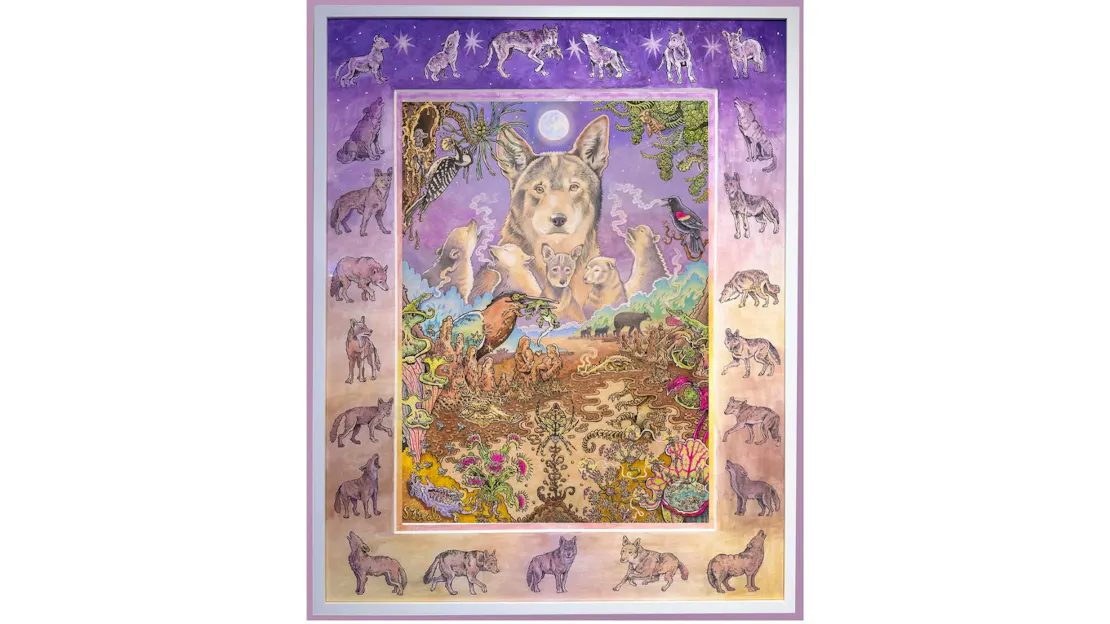
Beals currently lives in Asheville, North Carolina, where native wildlife is no stranger to his works. In January of 2025, he painted “Who Speaks for Red Wolves” in collaboration with Defenders. The work includes a representation of each critically endangered wild Red Wolf alive when Beals was painting it (23, though 6 died before the piece was finished) and, therefore, emphasizes how close we are to losing this beautiful animal. As of February 2026, there are 26 known wild Red Wolves, all of whom live in North Carolina.
4. KT Bryden
A picture is worth a thousand words, but with motion and sound, a movie can bring a story to life in an even larger way. Katie “KT” Bryden does just this as a conservation filmmaker.
Bryden grew up in New Jersey, relatively unaware of the environmental issues around her until she took an environmental science class at a local community college and it clicked for her that to protect the planet and all living creatures on it, she needed to harness the power of storytelling to help inspire and influence others to care and act.

Bryden’s most recent films are based in Florida. These projects highlight some of the state’s most endangered animals, including the Florida Panther and Florida Grasshopper Sparrow, and their ever-shrinking habitat.
5. Xiuhtezcatl Martinez
Visual art is not the only way to share your story and inspire others. Xiuhtezcatl (pronounced Sheoo-Tez-Caht) Martinez is an indigenous, environmental hip-hop (also known as “eco hip-hop”) artist. Born in Colorado, Martinez was raised to love, respect and celebrate nature. He discovered hip-hop music at a young age and uses his music as a way of communicating to and inspiring others to look at the world.
Martinez’s most recognizable song, “Speak for the Trees,” talks about deforestation and the destruction previous generations wreaked on the planet. The song also calls on the youth to stand up, speak out and act to preserve and restore nature.
Now, we challenge you. What inspires you? How can you inspire others to conserve nature and all the living creatures with whom we share the Earth?
Interested in learning about U.S. conservationists throughout time? Check out our new email-exclusive series! Sign up today.
Author